
Annature changelog
Identity verification 2.0 — Built for AML & CTF
Today we're releasing Identity verification 2.0 — the biggest update to our identity verification product since we launched it in 2022. This release introduces a new dashboard, a new billing structure, standalone AML & CTF screening, and a set of feature improvements many of you have been asking for.
This is a long post, but if you use identity verification in Annature, it's worth reading the whole thing — there's important information in every section.
Before I get into the detail, two important things to know up front:
If you're not a reporting entity under Tranche 2 obligations, most of what's changed doesn't apply to you. You get a new interface, some new features, and a cleaner billing line — but the way you send verifications and the way they work is mostly unchanged.
The pricing hasn’t gone up. The billing structure has changed to reflect the new product, but the total cost of a full verification with AML & CTF screening is the same as it was before. More detail below.
Walk through these changes live
I’m running two webinars next week covering everything in this post and the rest of the AML & CTF module. Same content each session — pick whichever works for you:
Wednesday 8 July, 11:00am AEST — Register here
Thursday 9 July, 2:00pm AEST — Register here
If you can't make either session, register for the recording — here — and we'll send it out once the live sessions have wrapped up.
Billing changes
Currently when you're subscribed to Identity verification, your invoices show two line items — Standard verifications and Enhanced verifications. Enhanced was everything included in Standard, plus the AML & CTF screening check.
Your next invoice will instead show:
Identity verifications — the equivalent of what was Standard
AML & CTF screening — the equivalent of what was previously bundled into Enhanced
So if you were previously sending 10 Enhanced verifications, your invoice would have shown Standard verifications: 0 and Enhanced verification: 10. Going forward, that same 10 verifications will show as Identity verifications: 10 and AML & CTF screening checks: 10.
The prices for these line items have adjusted proportionally — you are not being charged more. The total cost is identical to what you were paying before. We've simply separated the two components so they can be billed independently, which matters because...
AML & CTF screening now runs independently. Previously, AML & CTF screening was only available bundled with a verification. Now you can run standalone AML & CTF screening checks without doing a full identity verification, which is the right approach for many reporting entity workflows — particularly bulk-screening your existing client base. More on this further down.
Identity verification 2.0
Identity verification 2.0 launches today as a BETA. You'll see a new menu item in your navigation bar that takes you into it.
Right now, the old product and 2.0 are separate. Verifications you send from the old product won't appear in 2.0, and vice versa. This is deliberate for the transition period — data from each is kept isolated until the migration.
On 13 July, all data from the old product will be migrated into 2.0. From that point, the old product closes, and everything lives in 2.0.
Any verifications still in progress on 13 July will be cancelled during the migration and will appear as cancelled in 2.0. To avoid this, we recommend sending all new verifications from 2.0 during this interim period.
We strongly recommend you start sending all new verifications through 2.0 from today. This gives your in-progress verifications from the old product a week and a half to be completed before the 13 July migration.
Our data shows verifications are typically completed within 1-2 business days, so a week and a half is plenty of time for anything already in flight to finish before it’s affected.
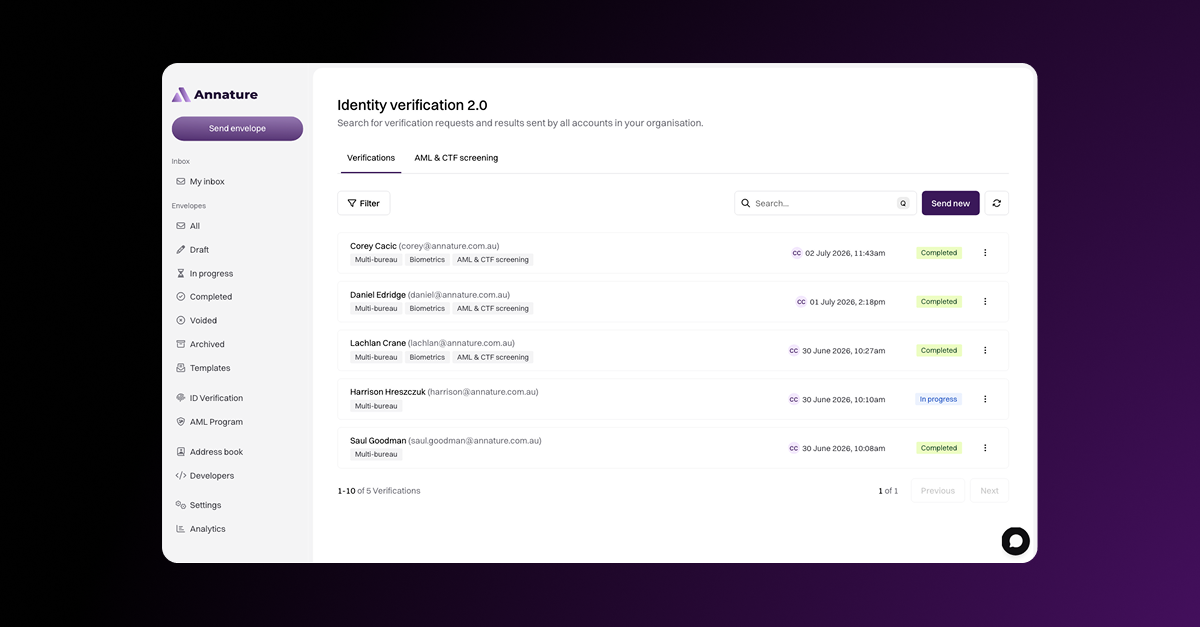
What's new in 2.0
We've used this opportunity to ship a set of improvements many of you have requested.
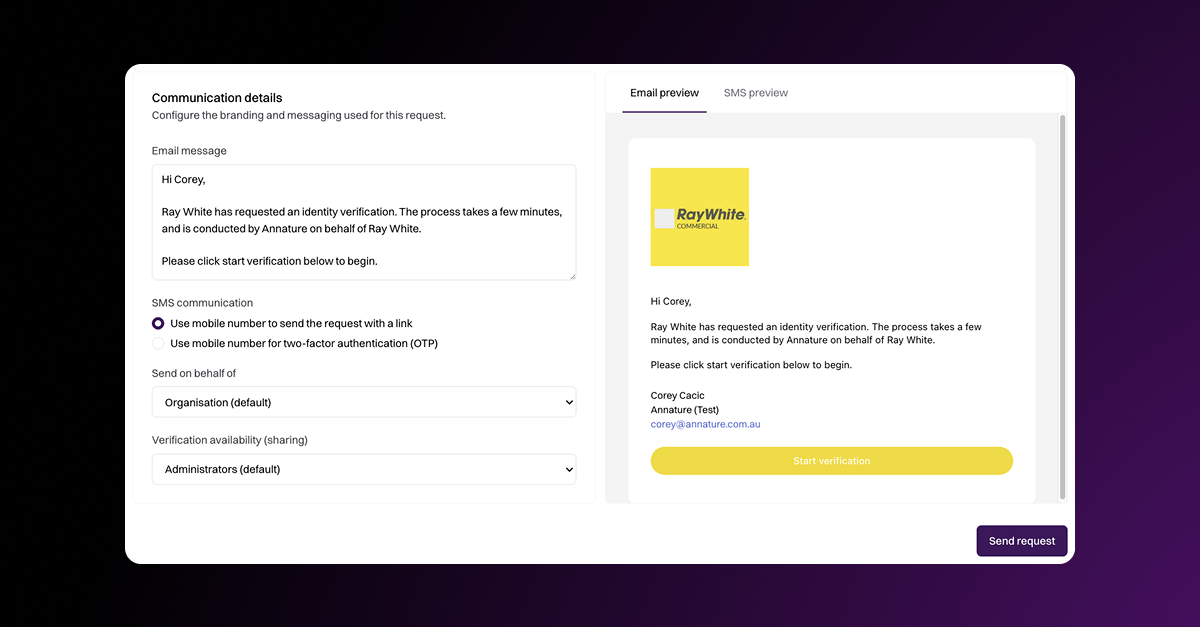
SMS with verification link. Previously, mobile numbers on a verification were only used for two-factor authentication, which meant the customer had to start from their email. When you enter a mobile number now, the default is to send an SMS containing the verification link — the same behaviour you get with envelopes. The customer can start from the SMS directly. If you'd rather use the mobile number for OTP as before, that option is still available.
Two-factor authentication on verifications served limited purpose anyway — a verification request is an empty form, not a document containing information that needs protecting. The link-first approach reflects how customers actually complete these requests, which is from their mobile phone.
Biometrics and AML & CTF screening are now on by default. The majority of our customers using the identity verification product are reporting entities, which means biometrics and AML & CTF screening are the sensible defaults. You now need to opt out of these if they don't apply to your use case.
Email and SMS customisation. You can now personalise the email and SMS messages sent when you create a verification, in the same way you customise messages when sending an envelope. Add a note, a personal introduction, or context specific to your client — helpful for reducing the "is this legitimate?" hesitation some recipients have with automated verification requests.
Availability (formerly Sharing). We've made a small change to how verifications are shared across organisations and groups. Sharing is now called Availability. If your organisation uses groups, the way verifications are sent from the organisation level versus from a specific group has been refined. The change is small but worth being aware of.
New required fields
Two new required fields for all verifications sent from 2.0:
Country of birth
Nationality or citizenship
Along with the existing required fields (full name, date of birth, address), these help sharpen AML & CTF screening results. When a screening check returns potential matches, the additional data narrows the results and helps build a more complete KYC profile of the customer.
If you're using Annature purely for identity verification without AML & CTF screening, these fields are still captured — the data doesn't cost you anything to collect and it's useful information to have on file.
Reviewing AML & CTF screening matches
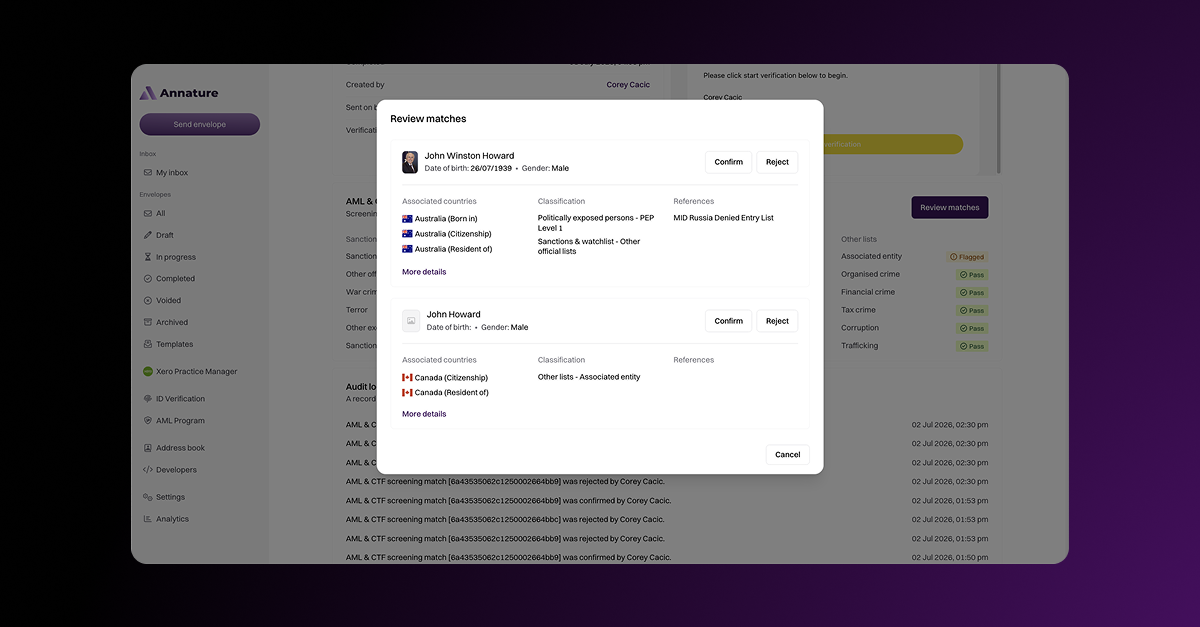
When an AML & CTF screening check returns results, you'll be shown the list of potential matches — individuals who share attributes (name, date of birth, country of origin, etc.) with the person you're screening. You can review each match individually and use your professional judgement to determine whether the match refers to the person you're actually engaging with.
An important thing to remember: AML & CTF screening checks often return matches by their nature. This is essentially the automated equivalent of an internet search — reviewing results to see which, if any, refer to the person you're actually working with — which AUSTRAC's own guidance endorses as a valid method for background and PEP checks.
There will be results. Your job is to use the information you've collected about the customer against the information shown in the match to make an assessment. In the vast majority of cases, potential matches will be false positives — the tool has done its job by surfacing them; you do yours by clearing them.
Standalone AML & CTF screening
We'll be covering this in more depth during our webinars next week, but the headline is:
For existing clients, you generally don't need to run a full identity verification. Reporting entities are expected to take a risk-based approach to CDD for existing clients. In most cases, this means running standalone AML & CTF screening to establish a baseline for each client and enrol them in ongoing monitoring — without needing to redo full identity verification for clients you've worked with for years.
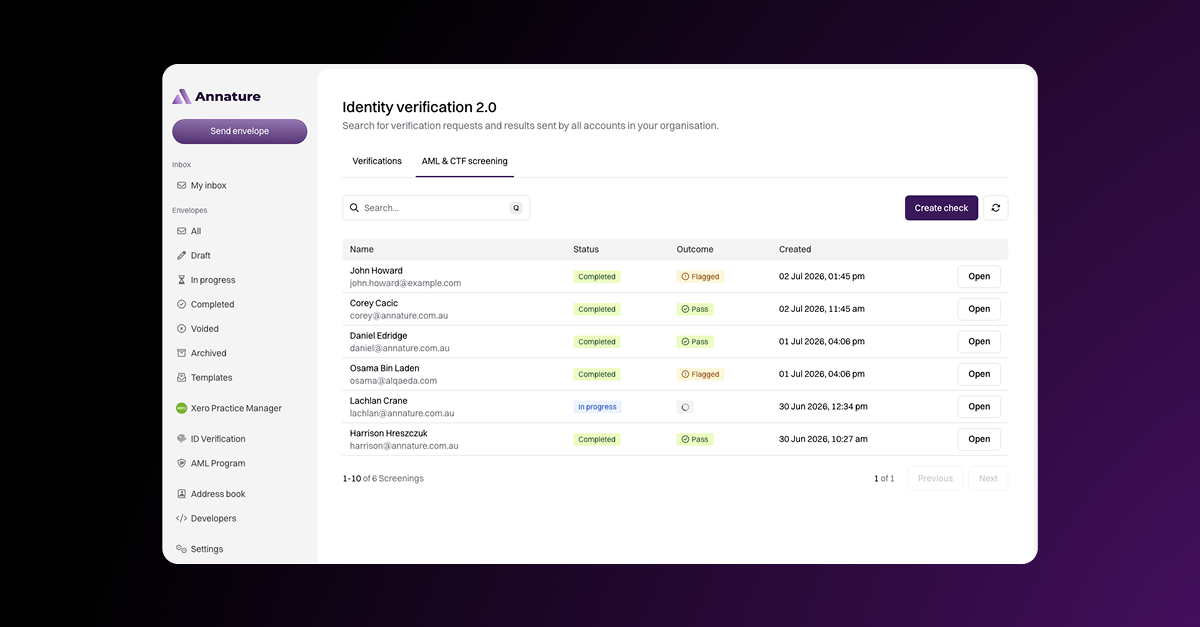
Standalone AML & CTF screening is now available as its own tab in 2.0. You'll also see all screening checks run as part of a full verification appearing in this same view, so you have a single place to review all your AML & CTF screening activity.
Ongoing monitoring — free of charge
One thing worth calling out: ongoing monitoring at Annature is free.
We've watched the industry over the last twelve months, with new AML compliance apps appearing regularly, most of them charging per client per month for ongoing monitoring. It's ridiculous pricing that adds significant recurring cost for a service that should just be part of doing the job properly.
When you run an AML & CTF screening check at Annature, ongoing monitoring is enabled by default and it is free for the next 10 years. We'd say forever, but forever is a long time.